Money
Emma Chamberlain’s Quiet Coffee Empire

When Emma Chamberlain launched Chamberlain Coffee in late 2019, the company didn’t feel like a celebrity licensing deal or a quick cash-grab from a high profile influencer. Chamberlain had been talking about coffee for years in her videos, often treating it as part of her daily routine rather than a curated lifestyle prop. The company’s first offerings were simple: bags of beans, cold brew packets, and an online storefront that leaned more playful than polished. What followed has been a slow expansion into one of the more visible creator-founded consumer brands of the past five years.

Emma Chamberlain made a name for herself in the mid-to-late 2010s through her unscripted YouTube vlogging. Her videos were sometimes travel diaries, often sprinkled with candid scenes of her trying new cafés or tinkering with cold brew at home. Those early moments built a loyal audience that trusted her voice and tastes. When she decided to turn that love of coffee into a business, her base of millions followed her transition not as a corporate pivot but as a natural evolution of her personal interests.

Chamberlain Coffee began as a direct-to-consumer business, built for an audience that already associated its founder with a certain kind of casual authenticity. Chamberlain’s YouTube career was defined by her rejection of the high-gloss influencer template. Her appeal came from how unproduced everything felt, even when it was carefully edited. Coffee was a recurring detail in that world, and the brand grew naturally out of it. By 2022, the company had started moving beyond internet novelty and influencer hype. According to multiple reports, Chamberlain Coffee raised $7 million in Series A funding, led by Blazar Capital and Chamberlain herself, as the company pushed further into retail and scaled distribution. Quoted in Forbes, Chamberlain described the company as an extension of her personal tastes rather than a detached business venture. This approach has been central to Chamberlain Coffee’s marketing approach from the beginning of the brand.
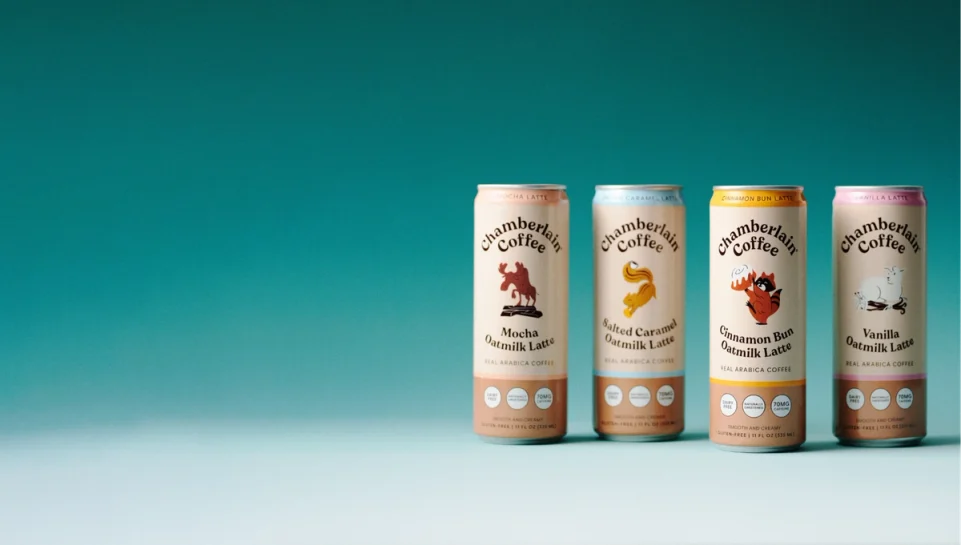
Chamberlain Coffee’s product line has expanded steadily. The brand now sells flavored blends, matcha, instant coffee and tea sticks, and branded accessories, like whisks, cups and bags. All of their items arrive in bright packaging that feels closer to Gen Z design language than traditional specialty coffee minimalism. The company has also emphasized sourcing and sustainability in its messaging, including partnerships that support farming communities. By 2024, the company was making a reported $20 million dollars in annual revenue. The brand forecasted $33 million dollars of revenue in 2025.
In recent years, the company has landed distribution in major chains including Target, Walmart, Whole Foods, and Sprouts, shifting the brand from something ordered online by fans into something encountered casually in grocery aisles. Starting with a limited edition online-only collaboration with lemonade company Swoon in 2022, followed by a collaboration with dairy-free creamer Nutpods the same year. In 2023, the brand then dropped an exclusive release at Walmart in 2022 of its plant-based coffee drinks, which was described by Chamberlain Coffee’s then-CEO Christopher Gallant as “a big moment for the brand”. In 2025, Chamberlain Coffee opened its first permanent café location in Los Angeles at Westfield Century City. The opening drew long lines, shifting towards a traditional retail environment where the product has to stand on its own.
Chamberlain Coffee also fits into a larger pattern of creators building consumer brands with longer shelf lives than merchandise lines. Unlike limited apparel releases, coffee is a repeat-purchase category, and the company has positioned itself around everyday use rather than collectibles. Chamberlain Coffee has distinguished itself from the standard branded t-shirt many creators sell. The company’s growth has come through incremental product additions and wider availability, not a single breakout moment.
Five years after launch, Chamberlain Coffee occupies a different space than it did in 2019. What began as a creator-led online shop is now a nationally distributed beverage brand. The brand has fully legitimized itself with venture capital backing, multiple major retail partners, and a first step into café operations. Chamberlain remains the face of the company, and became co-CEO in 2024, but the business itself has expanded into a standalone presence in grocery aisles and shopping centers well beyond her original audience.

