
News
New Zealand Moves to Ban Under-16s From Social Media
Christopher Luxon’s Online Safety Bill would wall under-16s off from Instagram, TikTok, Snapchat and Facebook. For creators, another country just shrank the audience that seeds virality.

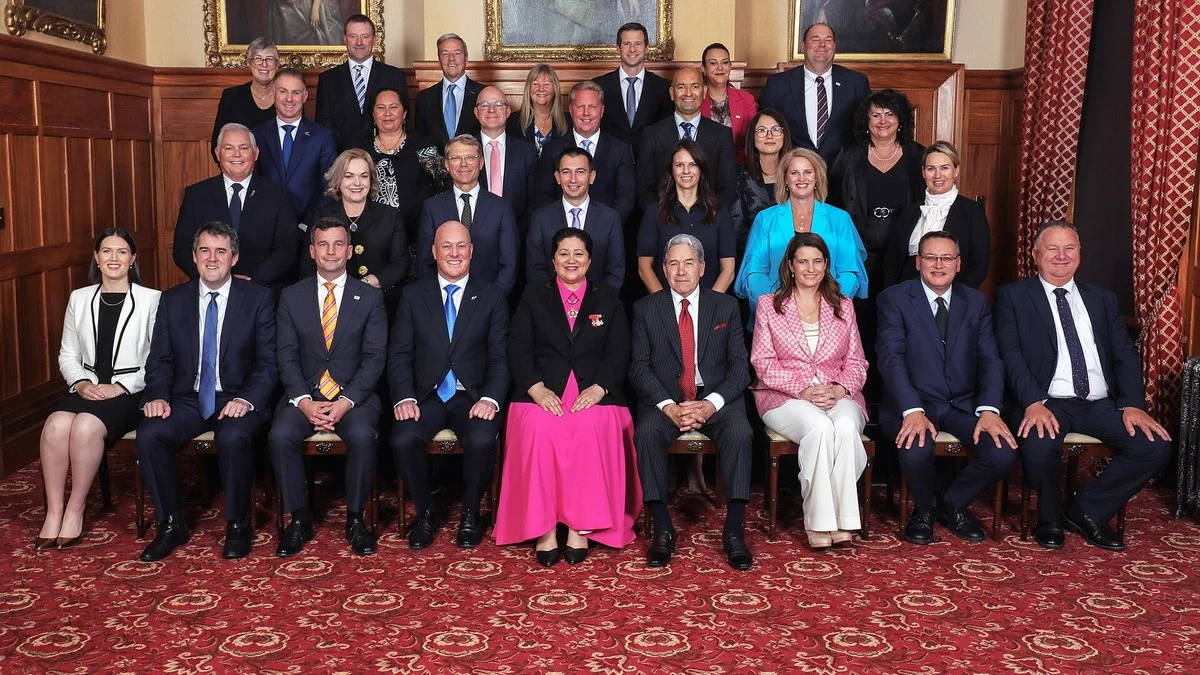
Appointment of the New Zealand government ministry 2023. Photo: Doug Mountain via Wikimedia Commons (CC0)
New Zealand Prime Minister Christopher Luxon introduced the Online Safety Bill on Monday, proposing to bar users under 16 from Instagram, TikTok, Snapchat and Facebook.
The bill would require those platforms to take reasonable steps to check that users are over 16, using methods including facial age estimation, digital ID services and formal identification. Platforms that fail to comply could face fines of up to 10 percent of their global revenue, the New Zealand Government said in a statement.
For creators, each national ban is a market-access event. The under-16 cohort is the group most likely to push a clip into virality and to harden into long-term fandom. New Zealand would wall that cohort off administratively, one country after Australia did the same in December 2025. A 10-percent-of-global-revenue penalty makes platform noncompliance economically untenable, which forces enforcement at the platform level that no creator can route around.
The audience is not small in habit. Luxon said one in three New Zealand children aged 13 to 17 now spend at least five hours a day on social media.
“We simply cannot accept the harm being done to a generation of New Zealand children,” Luxon said. He added that social media exposes children to “harmful content, addictive technology and pressures they are not equipped to deal with.”
Obligations under the bill rest entirely on the platforms. No penalties are proposed for children, parents or caregivers.
The proposal follows Australia’s world-first ban, which took effect December 10, 2025. Since then, Canada, Brazil and Indonesia have enacted their own under-16 restrictions, according to ABC News. The teen pool that feeds discovery algorithms is being fenced off country by country.
The New Zealand bill faces steep odds at home.
Two of the three parties in Luxon’s coalition oppose it. ACT leader David Seymour and NZ First leader Winston Peters both said their parties would vote against the bill, leaving it short of a coalition majority. Peters posted that his party was “concerned with the proposed legislation and the direction and slippery slope that legislation like this will inevitably take our country.”
Labour leader Chris Hipkins said his party would back the bill through a first reading. “With Labour’s support there is no reason for the government to delay the bill,” Hipkins said.
Even so, the government confirmed there is not enough parliamentary time. Parliament rises September 24 and dissolves October 1, ahead of the election.
The bill’s fate now rests with whoever forms the next government after New Zealanders vote on November 7.

News
Only 16% of YouTube Users Also Use Netflix, Data Shows
New Apptopia panel data lands as Netflix signs YouTube talent by the dozen. The catch: only 1 in 6 YouTube users also has Netflix, and the gap is widening.
Only about 16% of YouTube users also use Netflix, while about 92% of Netflix users also use YouTube, new consumer panel data showed Friday.
The figures come from Apptopia’s US consumer device panel, analyzed by Tubefilter on the day of publication. Apptopia’s Adam Blacker put it plainly in his bylined post: “In August, about 92% of Netflix users were also users of YouTube while only about 16% of YouTube users were also users of Netflix.”
The gap matters because Netflix has spent 2026 signing YouTube talent whose channels collectively hold more than 500 million subscribers, The Wrap reported. The 16% funnel means those creators reach a structurally smaller Netflix audience than their YouTube base. Netflix borrows the creators. It does not borrow their viewers.
The overlap was more balanced at the start of the year. Apptopia data shows the drop-off began in January, when Netflix started hosting original podcasts. Short-form arrivals since then have made the decline sharper.
Podcasts are not the only pressure. Netflix users increasingly cross over to microdrama apps like PineDrama and DramaBox throughout 2026. That is a second competitive front YouTube does not face in the same zero-sum way, because YouTube already hosts every one of these formats under one roof.
Netflix is paying several million dollars a year for co-exclusive rights that let creators upload to both YouTube and Netflix at once. The jury is still out on how much those deals boost Netflix’s engagement.
For a creator weighing a Netflix check, the panel data reframes the pitch. A deal built to add reach can instead strand a creator between two audiences that barely overlap, growing neither. Netflix is paying to license audiences that already live on YouTube, and the 16% number is a measure of how few of them follow.
News
Twitch Goes Dark Mid-Stream During GTA 6 Reveal
Twitch’s broadcasting tools stayed up while viewer access collapsed, stranding Kai Cenat and IShowSpeed mid-broadcast. A Netflix exclusivity window funneled a rare share of global traffic into a few channels at once.
Kai Cenat could still go live Thursday. His audience just could not reach him.
Twitch suffered a major outage on August 27, beginning minutes after Rockstar’s GTA VI Extended Look premiered exclusively on Netflix at 3:00 p.m. ET. The failure stranded top streamers including Cenat and IShowSpeed mid-broadcast on the platform where both built their live audiences.
The outage split the platform in an unusual way. Broadcasting tools stayed operational while viewer-side access failed, meaning creators were technically on-air to no one. That reversal cuts to the core of platform dependency for live creators. When viewer access collapses but the stream keeps running, audience monetization and algorithmic momentum both stall, even though the creator never left the desk.
The scale was in the reports. Forbes reported that Downdetector spiked past 17,000 users flagging problems with Twitch’s website, app and servers, with the platform acknowledging the outages around 4 p.m. EDT. Cenat’s and IShowSpeed’s livestreams and profiles were unavailable as of 4:45 p.m. EDT.
Twitch’s own status page confirmed the timeline. It acknowledged the incident at 20:09 UTC, labeling Web, Chat, and Video (Watching) as a major outage while Video (Broadcasting) stayed operational.
“We have received reports of impacted services. This could manifest in chat not working, login difficulties, search impaired, etc. We’re looking into the issue,” the company posted.
The trigger was the shape of the traffic, not its raw size. The Netflix exclusivity window ran the footage as a six-hour timed exclusive before Rockstar published it free on YouTube. Anyone without a Netflix subscription had two ways to see the 26 minutes of gameplay in real time: wait, or find a creator reacting live on Twitch.
Most did not wait.
That funneled a disproportionate share of global viewers into a handful of top channels at once, rather than spreading load across dozens the way an esports broadcast does. Twitch had opened a dedicated GTA VI category ahead of the event, a sign it expected heavy engagement. The plan held right up until the viewers arrived.
Newsweek reported that more than 17,000 people flagged the platform as unusable across web, chat and video, with profiles and livestreams failing to load before reports fell off and the issue cleared. The blackout ran roughly an hour by most accounts.
Twitch has not published a root-cause explanation. No source confirms whether the trigger was a CDN bottleneck, an authentication-service failure, or concurrent-viewer load exceeding provisioned capacity.
Twitch closed the incident at 02:31 UTC on August 28. “🛠 We have resolved all known negative service impacts,” the company posted. The GTA VI Extended Look reached YouTube and the official GTA VI site six hours after its Netflix premiere, ending the window that concentrated the traffic in the first place.
News
Netflix Bars Streamers From Co-Streaming GTA 6 Reveal
Netflix told a streamer that co-streaming its August 27 GTA 6 reveal is barred for six hours, locking gaming creators out of the year’s biggest first-look moment until the footage goes free.
Netflix will not allow streamers to co-stream or screen-share its August 27 premiere of “Grand Theft Auto VI: An Extended Look” during a six-hour exclusivity window, the company told a creator who asked directly.
The creator is Joseph Witty, who streams under the handle @Joseph_Witty. He called Netflix customer support to ask whether broadcasting the reveal would be permitted. Support told him no, citing digital rights. LevelUp corroborated the exchange.
The restriction lands on a valuable real-time moment for gaming creators this year. Co-streaming a major reveal is how live commentators earn: they react on camera while the footage plays, holding an audience that came for their take, not the trailer. Netflix’s window strips that away for six hours. Reaction and live-commentary streamers either sit out the premiere or wait until the footage goes free.
Netflix support told Witty he could not share his screen during a stream because it was tied to digital rights.
The footage does not stay locked away. It premieres on Netflix at 3 p.m. ET, then launches on Rockstar’s official YouTube channel and the Grand Theft Auto VI site at 9 p.m. ET the same day, per Rockstar Games’ newswire. That gap is the whole problem. The most-anticipated first gameplay of GTA 6 arrives during peak US afternoon hours, and creators cannot touch it live until night.
The stakes are set by the last two trailers. Trailer 1 has drawn 288 million YouTube views since December 2023, and Trailer 2 reached 176 million since May 2025, according to Variety. Those numbers route all of that first-viewing attention through a single paywalled feed.
Take-Two chief executive Strauss Zelnick has confirmed the window himself, telling Variety in earnings-call remarks that the footage would reach Rockstar’s YouTube channel six hours after its Netflix launch. He called the deal “a first of its kind partnership with Netflix.”
That first-of-its-kind framing is exactly what makes the policy a precedent worth watching. Netflix built its automated copyright system to protect film and television. Pointing it at a game trailer marks a new use, and it sets a template for what happens when a streaming platform buys a timed exclusive on gaming IP. The creators who built audiences on live event co-streaming are the ones a timed-exclusive model disadvantages first.
Earlier confusion made the ruling sharper. A company representative had suggested reactions were permitted, but that statement circulated out of context, LevelUp reported. Witty’s support call closed the gap between what creators hoped and what the platform will enforce.
The Extended Look is the final major marketing beat before GTA 6 launches on PlayStation 5 and Xbox Series X/S on November 19. The premiere runs August 27 at 3 p.m. ET. The free YouTube upload follows at 9 p.m.